Introducing Palabrisa
An overview of the Palabrisa API
Written by:
 Matt Rueter
2025-3-6
Tags:
Introducing the Palabrisa API: NLP-Powered Language Processing
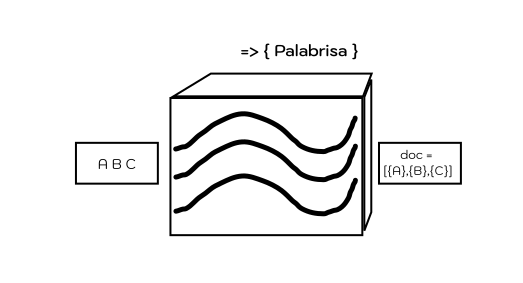
Language learning and natural language processing (NLP) are evolving together, making it easier than ever to build interactive, intelligent applications that help users engage with language in meaningful ways. I am currently developing Palabrisa, a Python-based API designed to process user input using NLP techniques and return structured objects that client applications can transform into dynamic exercises.
What is the Palabrisa API?
Palabrisa is a lightweight yet powerful API built with NLTK (Natural Language Toolkit) and spaCy, two of the most widely used NLP libraries in Python.
- NLTK is known for its comprehensive suite of tools for tokenization, stemming, and syntactic parsing. It provides a rich set of linguistic datasets and utilities that are invaluable for text processing and analysis.
- spaCy is optimized for speed and efficiency, offering pre-trained models that enable robust named entity recognition (NER), dependency parsing, and part-of-speech tagging.
By combining the strengths of these two libraries, Palabrisa efficiently processes text input, analyzes linguistic structures, and outputs structured data that can be used to create engaging language-learning exercises.
What is Palabrisa For?
Palabrisa is designed to serve as the language processing backbone for educational applications. It provides structured outputs that client apps can turn into interactive exercises, such as:
- Sentence restructuring activities
- Gap-fill exercises
- Vocabulary recognition and classification tasks
- Grammar-based challenges
By abstracting the complexity of NLP, Palabrisa allows developers to focus on designing rich, interactive learning experiences rather than handling raw text processing.
Why Develop It as an Isolated Project?
Palabrisa is being built as a standalone API to ensure flexibility and scalability. Rather than tying NLP logic directly into a specific application, this approach allows multiple projects within Parlanchín to seamlessly integrate Palabrisa for different use cases. Whether it's a web-based learning platform or a chatbot for conversational practice, Palabrisa provides a consistent and adaptable NLP solution.
Additionally, we see potential in making this publicly available for other developers interested in leveraging NLP for their own educational tools. By providing an easy-to-use, well-documented API, we aim to contribute to the broader ecosystem of language learning technology.
Stay tuned for more updates on Palabrisa’s capabilities and how it can enhance the way users interact with language!